Native records: 1 botanical areas
Philippines
See all areasDistribution is shown as WGSRPD Level 3 areas. It does not imply the species occurs throughout an entire area.
Last updated:
Distribution last verified:
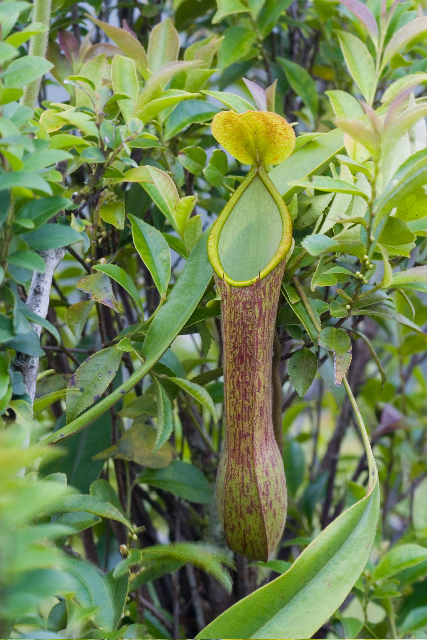
A carnivorous pitcher plant in the family Nepenthaceae, native to the Philippines (especially Luzon). It climbs through vegetation in montane rainforest and bears pitcher-shaped leaves that trap insects. Striking in form and shade-tolerant, it is widely cultivated as a houseplant, although true N. alata Blanco sensu stricto is Philippine endemic and much horticultural "N. alata" actually represents allied species or hybrids.
A climbing or scrambling sub-shrub whose stem may reach several metres, attaching itself to surrounding vegetation. The leaves are alternate and dimorphic: the midrib extends past the leaf blade into a tendril that terminates in an asymmetric pitcher 10–25 cm long. The pitchers bear two fringed wings running down the front (the ala that gives the species its name), a slippery peristome, an inner wall coated with waxy crystals, and a fluid-filled lower portion that digests trapped prey. Inflorescences are racemes of small yellowish-green to dark purple unisexual flowers; plants are dioecious. Native to montane rainforest on Luzon and other Philippine mountains at roughly 1,000–2,000 m elevation. Widely cultivated for its pitchers, but plants sold under the name "N. alata" in the horticultural trade are frequently N. graciliflora Elmer, hybrids, or other members of the N. alata group rather than N. alata Blanco sensu stricto (Cheek & Jebb, 2013).
Montane rainforest and mossy forest on Luzon and other Philippine mountains at around 1,000–2,000 m elevation. Typically grows as an epiphyte on trees, or rooted on steep shaded humid slopes and embankments, avoiding strong direct sunlight and requiring high atmospheric humidity year-round.
Philippines
The Köppen climate classes found in the areas this plant is recorded as native to. It does not mean an entire area has that climate.
The same climate occurs in 66 areas worldwide, 65 of which have no record of this plant. See them on the map
A matching climate does not mean the plant can grow there. Range limits are also set by things other than climate — dispersal history, soils, competition. Source: Beck et al. (2023), CC BY 4.0 (observed period 1991–2020).
Winged pitcher plant、Philippine pitcher plant
World Checklist of Vascular Plants (WCVP), version 2026-06-04
Philippines · Royal Botanic Gardens, Kew · wcvp_distribution.csv
Open source