Native records: 1 botanical areas
Mexico Northeast
See all areasDistribution is shown as WGSRPD Level 3 areas. It does not imply the species occurs throughout an entire area.
Last updated:
Distribution last verified:
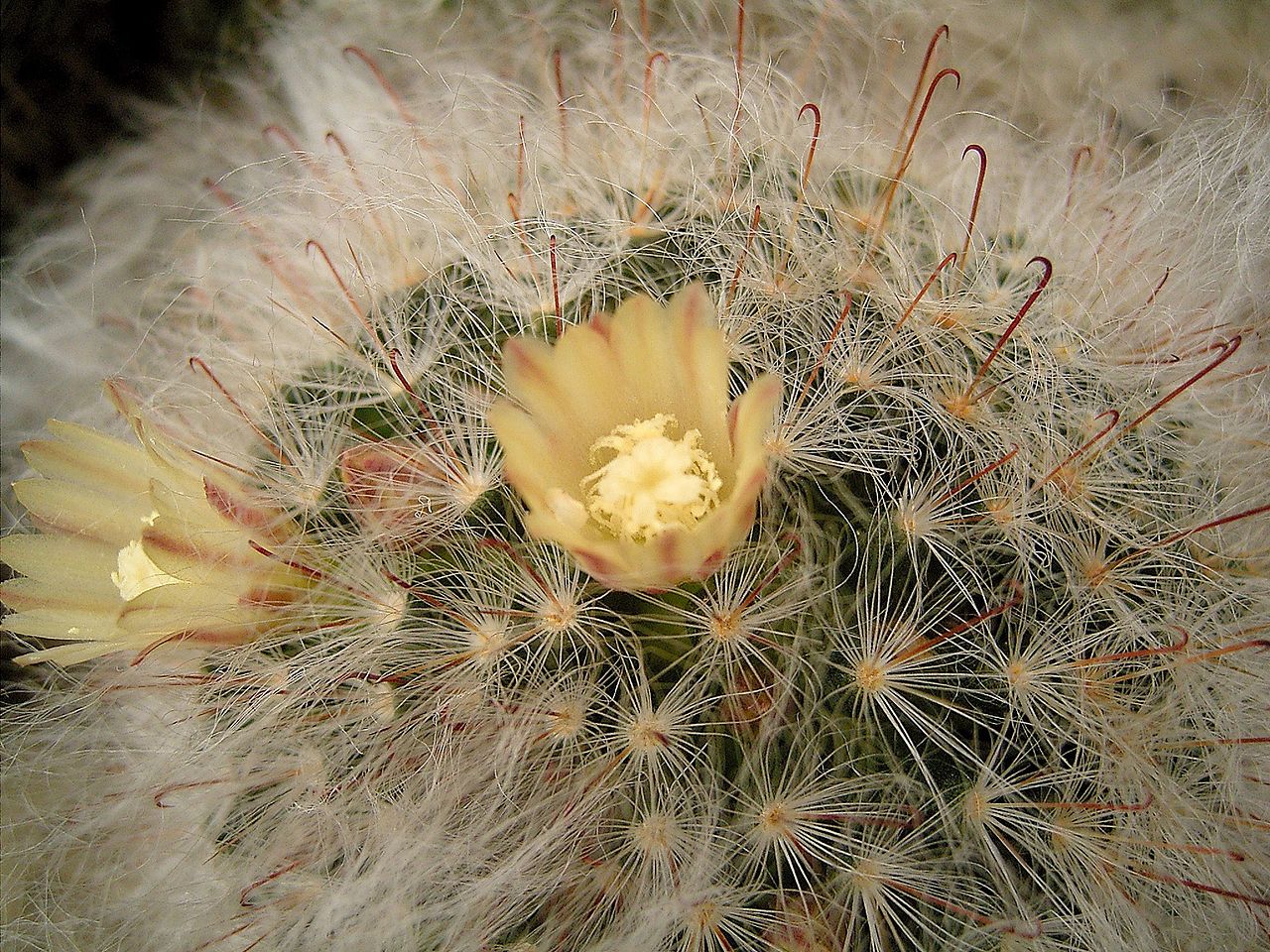
A small clumping cactus in the Cactaceae family, native to north-eastern Mexico. Spherical stems covered in a dense white fleece of radial spines and wool give the plant a powder-puff appearance; in spring and summer it bears a ring of small yellow to cream flowers near the stem apex.
A small caespitose cactus forming clumps of globose to shortly cylindrical stems 5–8 cm tall and 4–6 cm in diameter. Tubercles are cylindrical, with axils densely filled with white wool; each areole bears 20–30 white radial spines and 1–4 yellowish-brown to dark brown hooked central spines. The dense covering of white hair and spines gives the whole plant the powder-puff appearance that gives it its common name. Flowers appear in spring and summer in a ring near the stem apex, small, campanulate, yellow to cream. Fruits are elongated pink berries with black seeds. Tough, fast-growing and prolific, readily offsetting to form large clumps; widely cultivated as an ornamental succulent for its white fuzzy appearance and ring of small flowers.
Native to the arid semi-desert and dry shrubland of north-eastern Mexico (San Luis Potosí and the wider Mexico Northeast region), growing on limestone hills, slopes and rock crevices at elevations around 1,000–2,000 m. Adapted to strong sunlight and drought.
Mexico
The Köppen climate classes found in the areas this plant is recorded as native to. It does not mean an entire area has that climate.
The same climate occurs in 64 areas worldwide, 63 of which have no record of this plant. See them on the map
A matching climate does not mean the plant can grow there. Range limits are also set by things other than climate — dispersal history, soils, competition. Source: Beck et al. (2023), CC BY 4.0 (observed period 1991–2020).
Powder-puff cactus、Powderpuff cactus、Snowball cactus
World Checklist of Vascular Plants (WCVP), version 2026-06-04
Mexico · Royal Botanic Gardens, Kew · wcvp_distribution.csv
Open sourcePhotograph of Mammillaria bocasana
Frank Vincentz · CC BY-SA 3.0 · File page